


Access to Information law changes won’t open up PMO, cabinet offices
Prime Minister Justin Trudeau’s government is reneging on its election promise to make the Prime Minister’s Office and cabinet ministers’ offices subject to Canada’s Access to Information Act.
Instead, in proposed changes to the act introduced Monday, the government is promising to proactively release more information than it has in the past. For example, documents such as travel and hospitality expenses, briefing binders and mandate letters will be automatically made public.
Speaking to reporters Monday, Treasury Board President Scott Brison defended the government’s decision, focusing on the promise of expanded proactive disclosure rather than the broken promise of allowing Canadians to file requests to access documents in the offices of cabinet ministers or the prime minister.
At times, Brison seemed to conflate proactive disclosure, in which the government voluntarily makes public certain types of information, with the access to information law, which allows citizens to request documents that haven’t been made public to better understand government decisions and actions.
Many of the documents that would be proactively disclosed under the proposed legislation are already being voluntarily disclosed by the Trudeau government. Under previous governments, citizens would have had to file access requests to obtain copies of documents like briefing binders or mandate letters.
According to the amendments introduced Monday, proactive disclosure would also extend to the courts, raising the prospect of the travel and hospitality expenses of those sitting on the bench being made public for the first time. However, the government is also proposing to give court administrators the power to keep expenses secret if they believe that making the information public could jeopardize judicial independence.
More powers for watchdog
The government is also promising to give more teeth to Canada’s access to information watchdog.
Under the proposed changes, the information commissioner, who oversees the application of the access law, would get the power to issue binding orders for government departments to disclose information. If a government department wants to challenge the commissioner’s order, it would have to take its case to Federal Court.
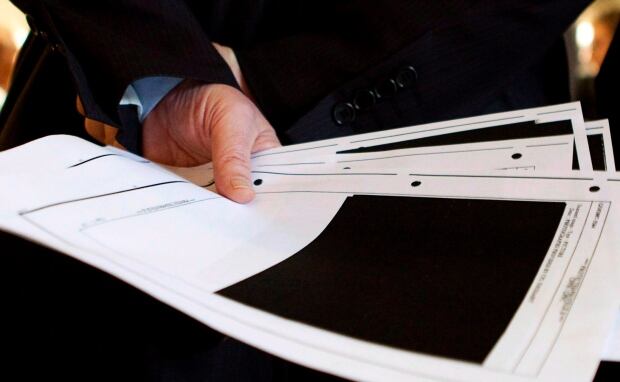
The Liberal government moved to reduce onerous search fees on Access to Information requests last year, but promised more far-reaching changes to the act. (Sean Kilpatrick/Canadian Press)
The Liberals are also planning to keep their promise to hold reviews of the access law every five years, with the first to take place within a year of royal assent of the proposed changes.
However, the government is planning to introduce a change it never talked about during the election campaign. The new clause would allow the information commissioner to refuse to investigate complaints judged to be frivolous or vexatious.
Currently, anyone who feels their Access to Information request hasn’t been handled properly can appeal to the information commissioner’s office.
Election promise
The legislation tabled Monday outlines the government’s plans to update the aging act, which has barely been touched since it was first introduced in 1983. The act allows Canadians, for a $5 fee, to request copies of government documents.
However, with Parliament expected to rise for the summer in coming days, the amendments unveiled by Brison, Democratic Institutions Minister Karina Gould and Justice Minister Jody Wilson-Raybould are unlikely to be debated before the fall.
Updating the Access to Information Act was a key part of the Liberal Party’s platform during the 2015 election, with Trudeau campaigning on a promise to make information open by default.
Not long after the election, the government moved to keep one of its election promises by ending the sometimes onerous search fees, which at times discouraged Canadians from using the act.
Other promises were more ambitious.
Trudeau promised that for the first time, the Access to Information law would apply to the Prime Minister’s Office, cabinet ministers’ offices as well as “administrative institutions that support Parliament and the courts.”
Trudeau also pledged to increase the powers of Canada’s information commissioner, giving them “the power to issue binding orders for disclosure.” In the past, the commissioner has sometimes had to turn to the Federal Court to enforce some of the commissioner’s rulings.
The Liberals also promised to carry out full legislative reviews of the Access to Information Act every five years.
Elizabeth Thompson can be reached at elizabeth.thompson@cbc.ca
Article source: http://www.cbc.ca/news/politics/access-information-government-secrecy-1.4167681?cmp=rss