

President Trump's options on Syria likely limited to cruise missile strike, experts say
CLOSE
The Pentagon has responded to President Trump’s warning to Russia to “get ready” for missile strikes on its ally Syria. Nathan Rousseau Smith has the story.
Buzz60
WASHINGTON – U.S. military officials are probably planning for a larger, more robust strike than the one U.S. warships launched April 7, 2017, in response to the Syrian regime’s use of chemical weapons, said a former senior Defense official familiar with planning for that attack.
The strategic aim, the former official said, would be to raise the cost to Syrian President Bashar Assad for using weapons prohibited by international treaty and to raise doubts in the minds of the military officers the next time he orders a similar attack. A suspected chemical weapons attack Saturday in a Damascus suburb killed at least 40 people, many of them children.Â
The former official spoke on condition of anonymity, lacking authorization to speak publicly about planning.
An attack on Syria, which President Trump threatened by tweet Wednesday, would be delivered by missiles instead of manned warplanes, and it could backfire, according to Loren Thompson, a defense industry consultant and military analyst at the Lexington Institute, a think tank.
Last week, Trump said he wanted to reduce the American presence in Syria.
“President Trump wants to reduce the U.S. military role in Syria while punishing the Assad regime’s use of chemical weapons,†Thompson said. “Those are contradictory goals. Attacking one side in Syria will draw the U.S. deeper into the civil war rather than reducing our role.â€Â
Officials from Russia, Assad’s patron, warned that their forces would shoot down U.S. missiles. The tangled civil war in Syria has seen Assad attack his own citizens, bolstered by Russian warplanes and Iranian supplies and troops.
The war has killed about 500,000 people and displaced millions.
Last year’s U.S. attack was limited to 59 Tomahawk cruise missiles aimed at destroying Syrian warplanes. It was one of the least lethal responses considered.
Pentagon planners are likely to hit similar targets this year, but they could expand their list to attack the pilots and commanders who ordered the use of chemical weapons, the former official said.Â
“Hitting people also sends a message that Assad himself could be next,” said Michael O’Hanlon, a military analyst at the Brookings Institution.Â
The Navy has destroyers in the Mediterranean capable of firing Tomahawk land-attack cruise missiles, which have a range of 1,000 miles.Â
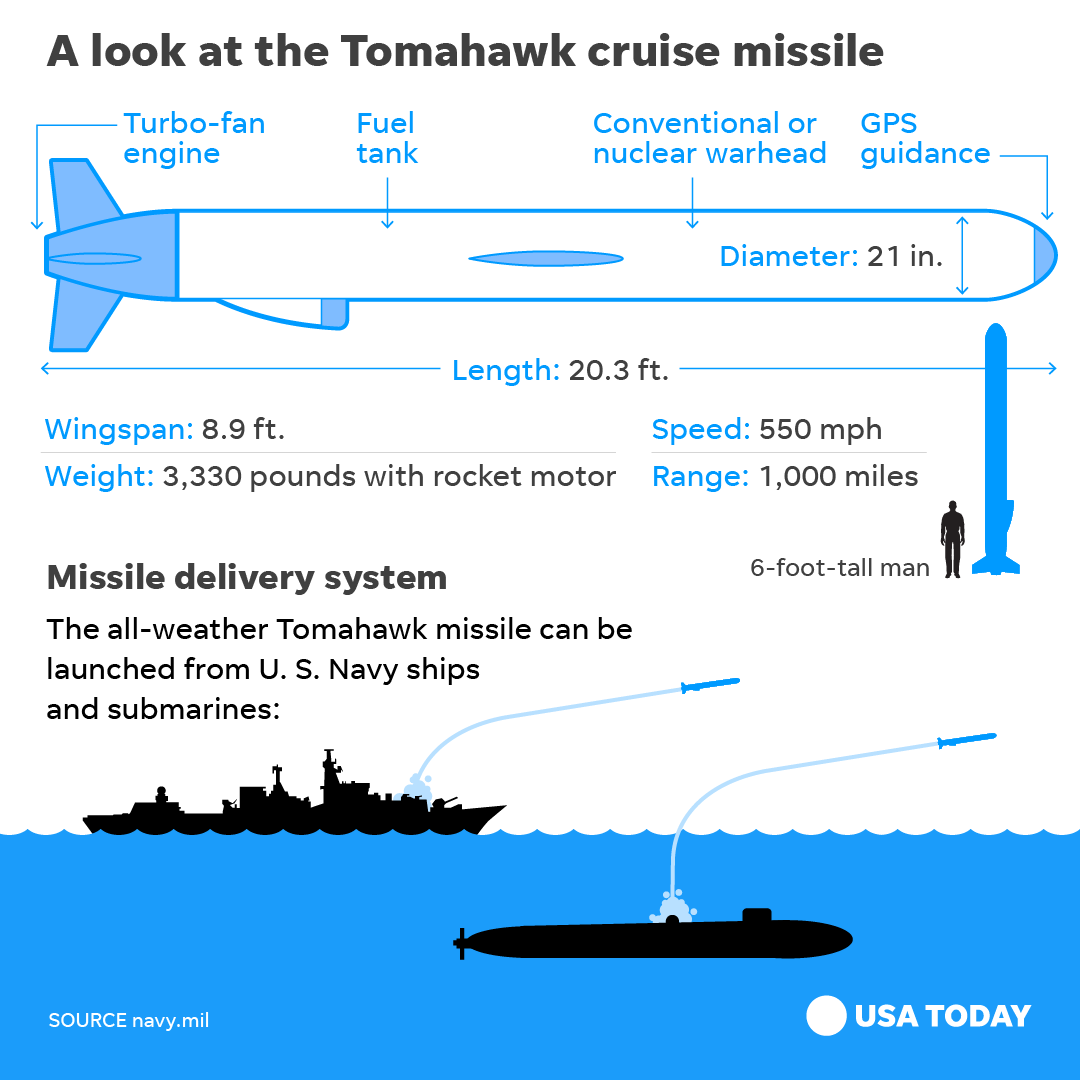
Â
Defense Secretary Jim Mattis said Wednesday that U.S. and allied officials were assessing intelligence related to the attack Saturday. The Pentagon will give military options for Trump to respond if he deems it necessary, Mattis said.
In 2017, Russia considered the U.S. attack to be a proportionate response and told Assad to absorb it without retaliating, the former official said. Assad did not respond. It is not in Russia’s interest to escalate the war, so the Russians would probably urge restraint again if the U.S. and allied attack was limited, the former official said.
Thompson wasn’t so sure.
“If Russian or Iranian troops are harmed by the U.S. attacks, that would broaden the scope of the conflict — perhaps sparking retaliation against the U.S. in other countries,†he said.
The 2,000 U.S. troops in Syria advising local forces on defeating Islamic State militants would be vulnerable to missiles, artillery and other attacks, the former official said.Â
British and French forces might be expected to take part in the response to the chemical attack, the former official said. They would probably use missiles that can be fired from a safe distance.
Posted!
The sister, left, of Mohammed Ismael, who died in one of three suicide car bombings claimed by the Islamic State group in the nearby town of Tal Tamr earlier this week, mourns during his funeral in Qamishli, a Kurdish-majority city in Syria’s northeastern Hasakeh province, on Dec. 13, 2015. Tal Tamr, in the Khabur region, is controlled by Kurdish forces and has been targeted in the past by IS jihadists, who in February overran much of Khabur and kidnapped at least 220 Assyrian Christians. Â
As seen from Mursitpinar in the outskirts of Suruc, at the Turkey-Syria border, a Turkish forces armored vehicle patrols the border road as in the background thick smoke rises following an airstrike by the US-led coalition in Kobani, Syria as fighting intensified between Syrian Kurds and the militants of Islamic State group, Sunday, Oct. 12, 2014. Kobani, also known as Ayn Arab, and its surrounding areas, has been under assault by extremists of the Islamic State group since mid-September and is being defended by Kurdish fighters.Â
Karim, an infant who was injured twice from bombings on Eastern al-Ghouta, rebel-held Douma, Syria is seen on Dec. 20, 2017. On Oct. 29 2017 Fadya, a Syrian woman who was displaced from al-Qisa, took her three-months old child Karim Abdul Rahman from Beit Sawa (a small area with no markets in eastern al-Ghouta) to Hamoria in order to buy home supplies, during her shopping the market with bombed by forces allegedly loyal to the Syrian regime, which led to her death and her son Karim, lost his eye. After spending 10 days at a hospital he was discharged to his house, in which another bombing led to a shrapnel to injure his skull. Activists worldwide launched a campaign in solidarity with Karim as a symbol for the besiegement of Eastern al-Ghouta, hundreds joined the campaign globally on social media on #SolidarityWithKarim, including the British ambassador to the UN Matthew Rycroft. Â
A picture taken from the Turkish side of the border between Turkey and Syria shows Syrian refugees waiting on the Syrian side of the border crossing near Akcakale, Sanliurfa province, south-eastern Turkey on June 10, 2015. More than 320,000 people are likely to have been killed in Syria’s civil war, the Britain-based Syrian Observatory for Human Rights monitoring group said on June 9. The organization said said it had been able to document the deaths of 230,618 people, including 69,494 civilians of whom more than 7,000 were children. The crisis in Syria started in March 2011 with peaceful demonstrations calling for more freedom from the repressive al-Assad regime, but quickly degenerated into violence after deadly crackdowns by security forces. Â
1 of 29
2 of 29
3 of 29
4 of 29
5 of 29
6 of 29
7 of 29
8 of 29
9 of 29
10 of 29
11 of 29
12 of 29
13 of 29
14 of 29
15 of 29
16 of 29
17 of 29
18 of 29
19 of 29
20 of 29
21 of 29
22 of 29
23 of 29
24 of 29
25 of 29
26 of 29
27 of 29
28 of 29
29 of 29
The use of allied manned warplanes would require destroying some of Syria’s air defenses, which include Russian-made S-400 surface-to-air missiles. Those systems encircle Damascus and some of Syria’s larger bases.
Scott Murray, a retired Air Force colonel who oversaw the targeting of Islamic State militants in Syria, said those air defenses almost assured a missile attack from the sea. He, like Thompson, worried about the Russian reaction.
“The wild card is the Russian piece,†said Murray, who called the Russian air defense in Syria “very formidable.”
“That leads me to believe another precise cruise missile strike is the only option,†he said.
Â