

Trump: Japan is 'winning' with free trade

CLOSE
On Nov. 3, Donald Trump embarks on a 12-day trip to five different Asian nations. North Korea and trade are expected to top his agenda as he tours Japan, South Korea, China, Vietnam and the Philippines.
Time
Starting his second day in Asia under under the cloud of another mass shooting in the United States, President Trump told business leaders in Japan that too many trade deals have benefited foreign partners at the expense of Americans.
“I have to say for the last many decades Japan has been winning — you know that,” Trump told Japanese and American business leaders meeting Monday morning in Tokyo, Sunday night in the United States.
Trump began his speech by citing more tragedy in the U.S., and pledging the federal government’s help to the victims of Sunday’s mass shooting at a church in Texas.
“All of America is praying to God to help the wounded and the families of the victims,” Trump said in Tokyo. “We will never ever leave their side.”
Trade is a major theme of a Trump trip that will also take him to meetings with leaders in South Korea and China, as well as economic conferences in Vietnam and the Philippines.
More: Trump arrives in Japan for start of Asia tour, says he’ll likely meet with Putin
More: Trump heads to Asia to talk trade, North Korea nukes
Trump has threatened to seek changes in various U.S. free trade deals, including one with South Korea; officials in other countries have said that Trump is exaggerating the shortcomings of free trade and underestimating the benefits to the United States.
Japan, in particular, criticized Trump for pulling the United States from the proposed Trans-Pacific Partnership, a massive agreement among Pacific Rim nations designed to increase economic activity and lower prices for all members.
In his meeting with Japanese and American business leaders, Trump said too many free trade deals have helped U.S. businesses move overseas, leaving behind newly unemployed Americans. He also complained about U.S. trade deficits, and said other countries need to open their markets to more American products.
“Our trade with Japan is not fair or open,” Trump said. “Not free or reciprocal.”
Posted!
First lady Melania Trump, and her Japanese counterpart Akie Abe, third from right, listen to sales manager Hajime Fukuju, left, during their visit to Mikimoto Ginza Main Store, Japan’s pearl jewelry maker, at the Ginza shopping district in Tokyo, Nov. 5, 2017.Â
President Trump, center, salutes, with first lady Melania Trump, top right, uoon arrival at the U.S. Yokota Air Base. On his first to Asia, Trump will visit Japan, South Korea, China, Vietnam and Philippines for summits of the Asia-Pacific Economic Cooperation (APEC) and the Association of Southeast Asian Nations (ASEAN).Â
 1 of 12
 2 of 12
 3 of 12
 4 of 12
 5 of 12
 6 of 12
 7 of 12
 8 of 12
 9 of 12
 10 of 12
 11 of 12
 12 of 12
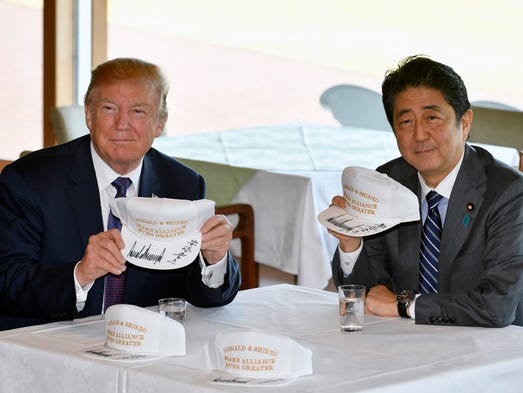
Trade will be one of the topics of Trump meetings Monday with Japanese leader Shinzo Abe. While the two leaders have gotten along in public, including while playing a round of golf on Sunday, they have different views of the trade issue.
Trump and Abe will also conduct a joint news conference on a day devoted largely to symbolic events.
The president and first lady Melania Trump planned to make a call on Emperor Akihito and Empress Michiko of Japan. They also greeted employees at the U.S. embassy in Tokyo.
Another event underscored a major theme of Trump’s Asia trip: Confronting North Korea over its nuclear weapons. Trump is urging Asian nations to put economic pressure on Kim Jong Un’s  government, trying to force it to give up nuclear weapons.
In Tokyo, Trump planned to address Kim’s aggression in a meeting with families of Japanese citizens who have been abducted by North Koreans.
On Monday evening, Abe will host a state banquet for Trump.
Follow David Jackson on Twitter: @djusatoday
Posted!
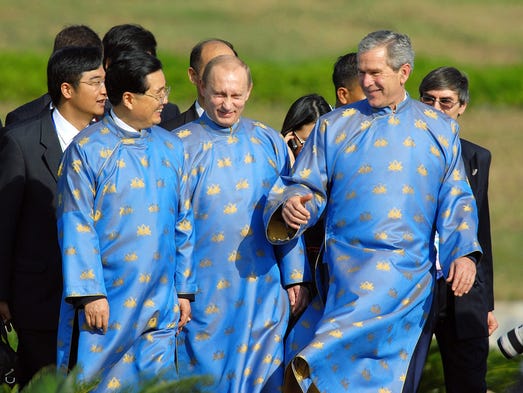
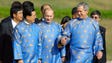
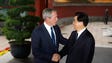
US President George W. Bush, right, chats with Chinese President Hu Jintao, left, and Russian President Vladimir Putin, center, at the end of the Asian-Pacific leaders meeting in Hanoi on Nov. 19, 2006. All 21 Asia-Pacific leaders wore dresses. But only the three women, pretty in pink, had the sartorial nerve to don the hats. Each year, the summit of the Asia-Pacific Economic Cooperation forum provides world leaders with an opportunity to strut their stuff in the traditional garb of the host country for the so-called “family photo”.Â
FILE – In this July 11, 1993, file photo, U.S. President Bill Clinton takes the lens caps off a pair of binoculars at Camp Casey, July 11, 1993, from the Ouellette guard post in the Demilitarized Zone (DMZ), the tense military border between the two Koreas, in Panmunjom, South Korea. Straddling the world’s most heavily fortified border, the Korean truce village of Panmunjom is a potentially dangerous flashpoint where North Korean soldiers hacked to death two American soldiers at the height of the Cold War. ItÂ’s also where the rival Koreas have held rare high-profile talks, and top American officials have visited to demonstrate American commitment to defending South Korea. (AP Photo/Greg Gibson, File) ORG XMIT: XSEL105 [Via MerlinFTP Drop]Â
 1 of 30
 2 of 30
 3 of 30
 4 of 30
 5 of 30
 6 of 30
 7 of 30
 8 of 30
 9 of 30
 10 of 30
 11 of 30
 12 of 30
 13 of 30
 14 of 30
 15 of 30
 16 of 30
 17 of 30
 18 of 30
 19 of 30
 20 of 30
 21 of 30
 22 of 30
 23 of 30
 24 of 30
 25 of 30
 26 of 30
 27 of 30
 28 of 30
 29 of 30
 30 of 30
Â
Article source: http://rssfeeds.usatoday.com/~/486765094/0/usatodaycomwashington-topstories~Trump-Japan-is-aposwinningapos-with-free-trade/